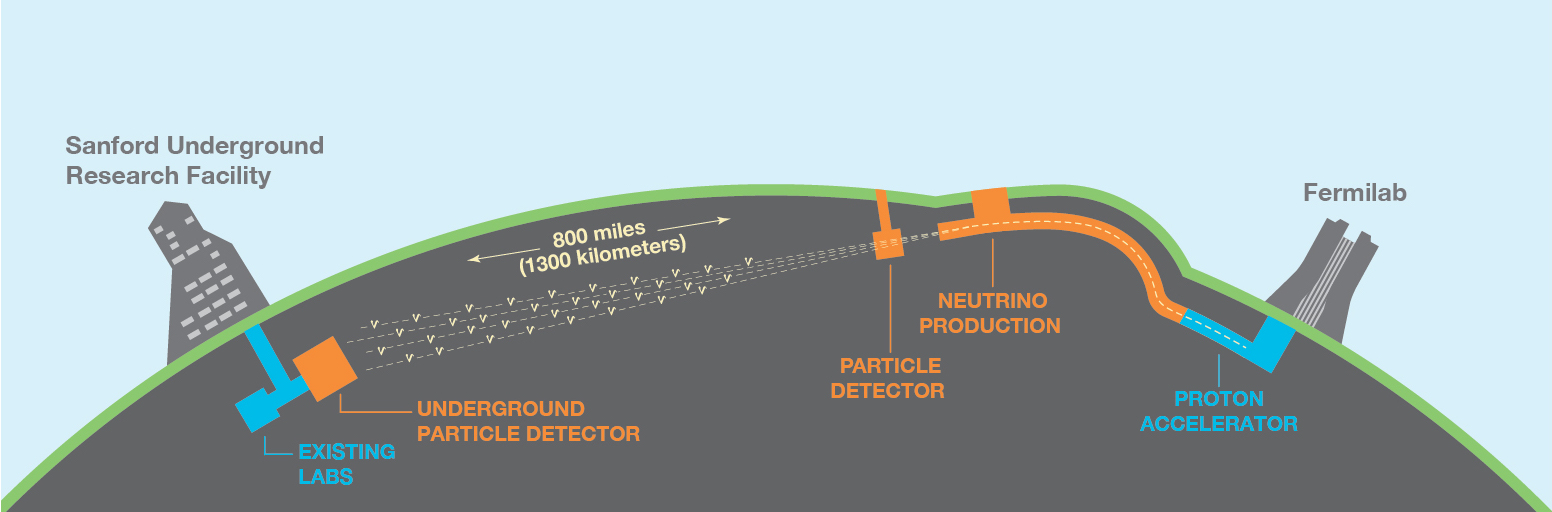


A neutrino can travel through the Earth without interacting with a single atom, therefore most leave no trace of their passage. To observe even just a few of the extremely rare interactions of neutrinos with matter, physicists build detectors with massive amounts of target material and run the experiments for several years. The detectors record signals from the detectable particles that have emerged from these rare collisions of neutrinos with atoms of the target material.
In its pre-conceptual design phase, the LBNE Project pursued two detector options: a water Cherenkov technology and a newer technology known as a Liquid Argon Time Projection Chamber (LArTPC). As of 2012, LBNE has narrowed its focus and plans to continue the development of only the LArTPC detector.
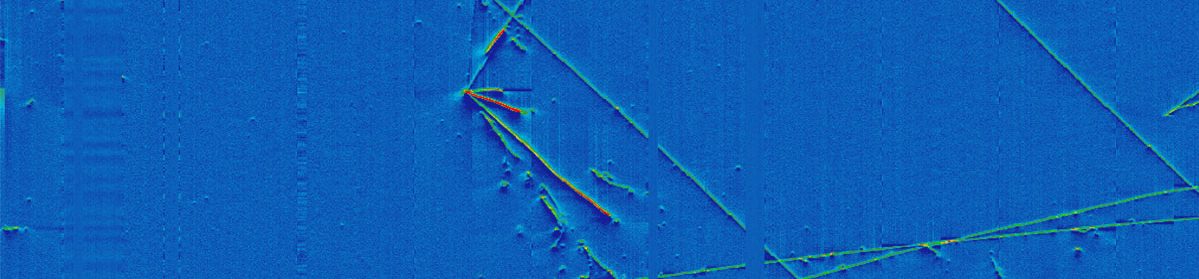
Argon, a gas at room temperature, condenses to a liquid when cooled to cryogenic temperatures. LArTPC technology uses liquid argon (LAr) as a target material. The detection method is based on the collection of ionization electrons, resulting from particle interactions in the liquid argon, onto wire planes immersed in the fluid. Under the influence of an electric field, the electrons drift to the wire planes, thereby creating a signal. A predecessor experiment at Fermilab, MicroBoone, will build a 100-ton LArTPC, whereas LBNE's conceptual design as of April 2012 describes a 34-kiloton detector at a depth of 4850 ft. Due to the reconfiguration effort in the spring of 2012, the size and location of the far detector may change.
The water Cherenkov technology works much differently. In a water Cherenkov detector, charged particles are created in collisions of neutrinos with water molecules. These charged particles travel faster than the speed of light in the water, causing them to emit what is called Cherenkov light. The light radiates out in a cone around the direction of the initial charged particle, projecting a ring pattern on the opposite side of the detector. An array of light detectors surrounds the water volume to record these rings of light, no matter their direction of travel.
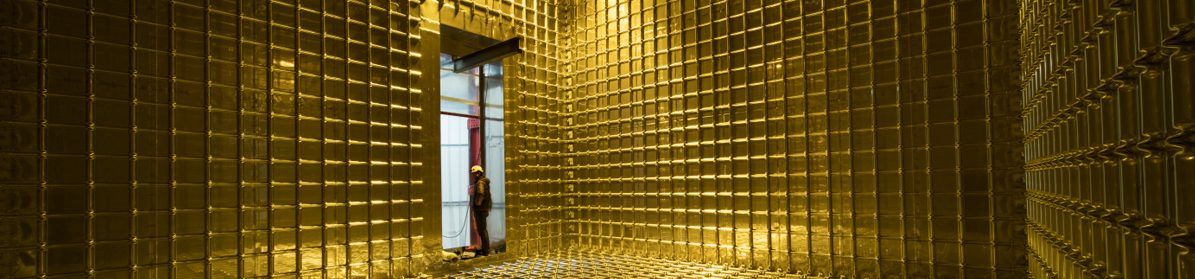
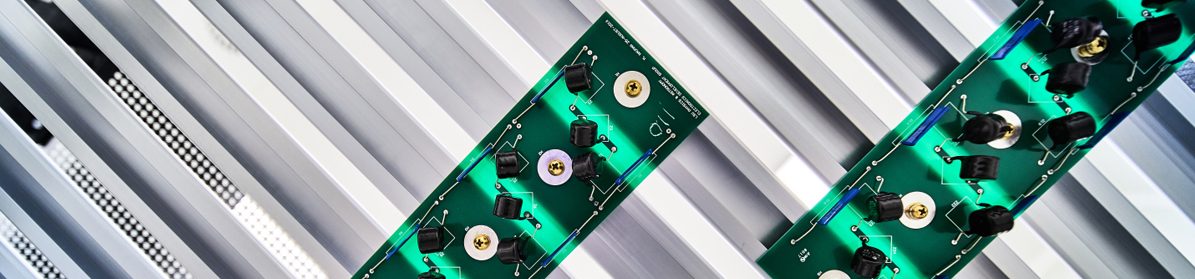
The largest neutrino detector to date is a 50,000-ton water Cherenkov detector in Japan called Super-Kamiokande. It is placed 3300 feet underground in a cylindrical cavern about 40 meters high and 40 meters wide. The cavern is filled with water and on its walls is an array of light-sensitive devices called photomultiplier tubes (PMTs). The depth of the detector shields it from cosmic rays, which are abundant and would generate signals in the detector that serve only to complicate the data analysis. Not all, but most cosmic rays get absorbed by the matter above the detector.
The largest existing LArTPC neutrino experiment is ICARUS, located at the Gran Sasso National Laboratory in Italy. It uses a detector containing 600 tons of liquid argon target material to detect the arrival of neutrinos sent through 730 km of rock from the CERN laboratory in Switzerland. The ICARUS detector is composed of two symmetric, LAr-filled, instrumented modules seated inside of vacuum-tight cryostats roughly 3.5 by 4 by 20 cubic meters in size. It is also located underground to reduce unwanted signals from cosmic rays.

|
|
||||
|
|